
Friday, March 16, 2012


Wednesday, March 14, 2012
Number of people in poverty reaches highest level in 51 years
WASHINGTON — The income of American households fell only slightly last year despite the severe recession because of income gains among the elderly, the Census Bureau reported Thursday.
But the number of people in poverty reached its highest level in 51 years.
Median household income was $49,777 in 2009, down 0.7% from a year earlier, a change that was not statistically different from 2008, the agency said.
"The good news is there's less bad news than we thought," says Sheldon Danziger of the Population Studies Center at the University of Michigan.
He says the federal stimulus law appears to have boosted income more than expected by, for example, providing extended unemployment benefits and a $250 bonus for Social Security reciipients. Census Bureau division chief David Johnson says unemployment benefits kept 3.3 million people out of poverty in 2009.
Social Security kept 14 million seniors above the poverty level, he says.
Households headed by people 65 and older enjoyed a 5.8% increase in income, boosted by increased Social Security provided by the federal stimulus law. Those gains offset income drops in households headed by people 45 and under.
Income for middle-aged households — headed by people 45 to 64 — was unchanged.
The effects of the recession were apparent elsewhere in the numbers. The poverty rate rose to 14.3%, up from 13.2% in 2008.
A total of 43.6 million people lived in poverty last year, up from 39.8 million in 2008 — the third consecutive annual increase. Extended unemployment benefits lifted 3.3 million people out of poverty, compared with 900,000 in 2008.
"Today, the Census Bureau released data that illustrates just how tough 2009 was: along with rising unemployment, incomes failed to rise for the typical household, the percentage of Americans without health insurance rose to 16.7%, and the percentage of Americans living in poverty increased to 14.3%" President Obama said in a statement.
Child poverty passed the 20% threshold for the first time since 1996, fueled by a large gain among white children — from 10.6% to 11.9%, said William Frey, a demographer at the Brookings Institution.
"Hispanics are increasingly becoming the face of child poverty, overtaking the number of poor black kids in 2002 and the number of poor white kids in 2007," Frey said.
But whites also are experiencing a significant gain in child poverty rates.
"White families with children have been significantly hit by the recession as well," Frey said. "Politically, this means that concerns about the economy will be affecting poor white kids in the suburbs as well as minorities in general."
The poverty measure is imperfect because it does not include the value of key safety-net programs such as food stamps, Medicaid and the Earned Income Tax Credit. The government defined poverty for a family of four in 2009 as an income of $21,954 or less.
The number of people without medical insurance rose by 4.4 million to 50.7 million. In 2009, 16.7% of people had no medical coverage, up from 15.4% a year earlier. The jump in the ranks of the uninsured stemmed from a large drop in the number of people with private and employment-based insurance, a trend fed by high unemployment.
In 2009, households in the West and Northeast had the highest median household incomes. Real median income declined from 2008 to 2009 in the Midwest and West; changes for the Northeast and South were not statistically significant.
Among race groups, Asian households had the highest median income in 2009. Real median income declined from 2008 to 2009 for non-Hispanic white and black households, while the changes for Asian and Hispanic-origin households were not statistically different.
The Census data are closely watched because they are the broadest measure of the financial health of Americans.
Robert Rector, a senior fellow at the conservative Heritage Foundation, said the government spent about $20,000 per poor person this year, not counting Social Security.
"People got a lot of money, but the idea that giving people money was going to create employment has failed," he said. "We've had an unprecedented surge in welfare spending, on cash and goods in medical programs for low income and poor Americans."
Broken down by state, Mississippi had the highest share of poor people, at 23.1%, according to rough calculations by the Census Bureau. It was followed by Arizona, New Mexico, Arkansas and Georgia. On the other end of the scale, New Hampshire had the lowest share, at 7.8%.
Other findings from the report:
• In 2009, households maintained by naturalized citizens had the highest median income.
• In 2009, the earnings of women who worked full time were 77% of that for men. The real median earnings of men who worked full time rose by 2% from 2008 to 2009, from $46,191 to $47,127. For women, the corresponding increase was 1.9%, from $35,609 to $36,278.
But the number of people in poverty reached its highest level in 51 years.
Median household income was $49,777 in 2009, down 0.7% from a year earlier, a change that was not statistically different from 2008, the agency said.
"The good news is there's less bad news than we thought," says Sheldon Danziger of the Population Studies Center at the University of Michigan.
He says the federal stimulus law appears to have boosted income more than expected by, for example, providing extended unemployment benefits and a $250 bonus for Social Security reciipients. Census Bureau division chief David Johnson says unemployment benefits kept 3.3 million people out of poverty in 2009.
Social Security kept 14 million seniors above the poverty level, he says.
Households headed by people 65 and older enjoyed a 5.8% increase in income, boosted by increased Social Security provided by the federal stimulus law. Those gains offset income drops in households headed by people 45 and under.
Income for middle-aged households — headed by people 45 to 64 — was unchanged.
The effects of the recession were apparent elsewhere in the numbers. The poverty rate rose to 14.3%, up from 13.2% in 2008.
A total of 43.6 million people lived in poverty last year, up from 39.8 million in 2008 — the third consecutive annual increase. Extended unemployment benefits lifted 3.3 million people out of poverty, compared with 900,000 in 2008.
"Today, the Census Bureau released data that illustrates just how tough 2009 was: along with rising unemployment, incomes failed to rise for the typical household, the percentage of Americans without health insurance rose to 16.7%, and the percentage of Americans living in poverty increased to 14.3%" President Obama said in a statement.
Child poverty passed the 20% threshold for the first time since 1996, fueled by a large gain among white children — from 10.6% to 11.9%, said William Frey, a demographer at the Brookings Institution.
"Hispanics are increasingly becoming the face of child poverty, overtaking the number of poor black kids in 2002 and the number of poor white kids in 2007," Frey said.
But whites also are experiencing a significant gain in child poverty rates.
"White families with children have been significantly hit by the recession as well," Frey said. "Politically, this means that concerns about the economy will be affecting poor white kids in the suburbs as well as minorities in general."
The poverty measure is imperfect because it does not include the value of key safety-net programs such as food stamps, Medicaid and the Earned Income Tax Credit. The government defined poverty for a family of four in 2009 as an income of $21,954 or less.
The number of people without medical insurance rose by 4.4 million to 50.7 million. In 2009, 16.7% of people had no medical coverage, up from 15.4% a year earlier. The jump in the ranks of the uninsured stemmed from a large drop in the number of people with private and employment-based insurance, a trend fed by high unemployment.
In 2009, households in the West and Northeast had the highest median household incomes. Real median income declined from 2008 to 2009 in the Midwest and West; changes for the Northeast and South were not statistically significant.
Among race groups, Asian households had the highest median income in 2009. Real median income declined from 2008 to 2009 for non-Hispanic white and black households, while the changes for Asian and Hispanic-origin households were not statistically different.
The Census data are closely watched because they are the broadest measure of the financial health of Americans.
Robert Rector, a senior fellow at the conservative Heritage Foundation, said the government spent about $20,000 per poor person this year, not counting Social Security.
"People got a lot of money, but the idea that giving people money was going to create employment has failed," he said. "We've had an unprecedented surge in welfare spending, on cash and goods in medical programs for low income and poor Americans."
Broken down by state, Mississippi had the highest share of poor people, at 23.1%, according to rough calculations by the Census Bureau. It was followed by Arizona, New Mexico, Arkansas and Georgia. On the other end of the scale, New Hampshire had the lowest share, at 7.8%.
Other findings from the report:
• In 2009, households maintained by naturalized citizens had the highest median income.
• In 2009, the earnings of women who worked full time were 77% of that for men. The real median earnings of men who worked full time rose by 2% from 2008 to 2009, from $46,191 to $47,127. For women, the corresponding increase was 1.9%, from $35,609 to $36,278.
Monday, March 12, 2012
Saturday, February 25, 2012
Fed official warns of higher interest bill for Uncle Sam
NEW YORK (CNNMoney) -- The Federal Reserve takes a lot of heat from critics for keeping interest rates low. But there's an upside that most people overlook: Low interest rates save the government money.
Speaking at a conference on monetary policy Friday, New York Fed President William Dudley stressed how lower rates reduce the interest that the federal government pays on the national debt.
*
*
*
* Print
* Comment
In addition, the Fed's policies have also led to larger payoffs for the U.S. government. By making huge asset purchases over the last couple of years in order to keep rates down, the Fed is also earning interest on those investments. That money gets returned to the Treasury. Last year, the Fed sent about $77 billion to the Treasury, more than double what it was earning before the financial crisis.
"The interest bill on the growing federal debt burden has been temporarily restrained by the low level of interest rates and high level of remittances from the Federal Reserve to the Treasury," Dudley said at the U.S. Monetary Policy Forum presented by the University of Chicago Booth School of Business on Friday.
The event is essentially a meeting of minds between Federal Reserve officials, members of foreign central banks and economists from some of the world's largest banks and top universities.
Dudley pointed out that the Fed determines monetary policy based on economic activity -- not the government's debt bill.
Why the Federal Reserve can't fix housing
That said, it would behoove fiscal policymakers (meaning Congress and the president) to think ahead to rosier days, when eventually, tighter monetary policy will raise the government's interest bill.
That's exactly why lawmakers need to come up with a credible plan for the nation's debt now, he said.
"The United States faces substantial fiscal challenges in the years ahead," Dudley said in prepared remarks. "In one important respect -- net interest expense -- these challenges may be more daunting that fully appreciated currently."
Dudley also recommended the U.S. focus on increasing exports -- one of Obama's chief goals -- as a means of rebalancing its trade gap. When imports grow faster than exports, it subtracts from economic growth.
He also urged countries that have large trade surpluses -- like China -- to "reorient their economies over time toward increasing domestic demand." To top of page
First Published: February 24, 2012: 2:30 PM ET
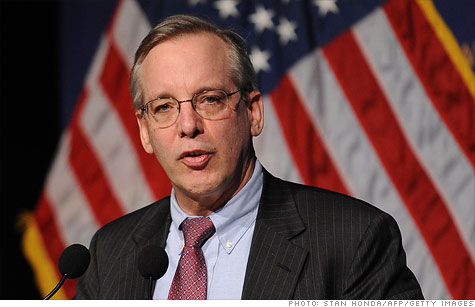
Speaking at a conference on monetary policy Friday, New York Fed President William Dudley stressed how lower rates reduce the interest that the federal government pays on the national debt.
*
*
*
* Comment
In addition, the Fed's policies have also led to larger payoffs for the U.S. government. By making huge asset purchases over the last couple of years in order to keep rates down, the Fed is also earning interest on those investments. That money gets returned to the Treasury. Last year, the Fed sent about $77 billion to the Treasury, more than double what it was earning before the financial crisis.
"The interest bill on the growing federal debt burden has been temporarily restrained by the low level of interest rates and high level of remittances from the Federal Reserve to the Treasury," Dudley said at the U.S. Monetary Policy Forum presented by the University of Chicago Booth School of Business on Friday.
The event is essentially a meeting of minds between Federal Reserve officials, members of foreign central banks and economists from some of the world's largest banks and top universities.
Dudley pointed out that the Fed determines monetary policy based on economic activity -- not the government's debt bill.
Why the Federal Reserve can't fix housing
That said, it would behoove fiscal policymakers (meaning Congress and the president) to think ahead to rosier days, when eventually, tighter monetary policy will raise the government's interest bill.
That's exactly why lawmakers need to come up with a credible plan for the nation's debt now, he said.
"The United States faces substantial fiscal challenges in the years ahead," Dudley said in prepared remarks. "In one important respect -- net interest expense -- these challenges may be more daunting that fully appreciated currently."
Dudley also recommended the U.S. focus on increasing exports -- one of Obama's chief goals -- as a means of rebalancing its trade gap. When imports grow faster than exports, it subtracts from economic growth.
He also urged countries that have large trade surpluses -- like China -- to "reorient their economies over time toward increasing domestic demand." To top of page
First Published: February 24, 2012: 2:30 PM ET
New York Fed President William Dudley
Wednesday, February 22, 2012
Re: How to Promote Your Website
These are some tips to improve the visibility of your site
1. Update your site regularly
2. Link to your website from other sites
3. Give away content
4. Link to authority sites from your site
5. Write link bait
6. Forum Posting
7. Blog Commenting
8. Directory Submission
9. Article Submission
10. Social Bookmarking
11. Effective content of website-
1. Update your site regularly
2. Link to your website from other sites
3. Give away content
4. Link to authority sites from your site
5. Write link bait
6. Forum Posting
7. Blog Commenting
8. Directory Submission
9. Article Submission
10. Social Bookmarking
11. Effective content of website-
Friday, February 17, 2012
Subscribe to:
Posts (Atom)